This post is brough to you by Clagaryspeeddating.com - sign up for an event to meet real singles in calgary.
How can introverts succeed at speed dating? It's a fair question to ask at 11 PM the night before your first event, lying awake running through all the ways it could go sideways. A room full of strangers. A bell ringing every few minutes. Small talk, on demand, over and over again. For introverts, that mental preview can feel less like excitement and more like a mild threat.
Here's the thing, though: speed dating was not designed for the loudest person in the room. It was designed for focused, one-on-one conversation in a structured setting where someone else manages the clock. That description fits introverts far better than most people realize. Calgary Speed Dating events are built around exactly this kind of format: professionally hosted, low-pressure, and structured so that the social pressure points most introverts dread are already accounted for in the event design. That structure alone quietly removes a lot of what makes a typical night out feel exhausting.
By the time you finish this article, you'll have a concrete pre-event plan, a ready-to-use bank of conversation starters, an energy management strategy for the rounds, and a follow-up template that actually gets a response. Here's how to make that night work for you.
Most introverts don't dread connection. They dread the noise around it: deciding when to approach someone, figuring out how to exit gracefully, and filling two hours of unstructured social time with something that doesn't feel hollow. Speed dating eliminates all three of those problems before you even sit down. The rotation is managed by a host, the exit is automatic, and the format is timed. There is no cold approach, no awkward hover near the door, no wondering whether you've stayed too long.
Many researchers and psychologists who study introversion suggest that introverts aren't bad at connecting, they're often uncomfortable with the performance that surrounds it. Strip that away and what you're left with is a series of genuine, focused, one-on-one conversations, which is exactly where many introverts do their best work.
At a typical speed dating event, half the group stays seated and the other half rotates to the next seat when the host signals the round is over. Each round runs approximately five minutes, and the whole evening spans two to three hours including mingling time and a midpoint break. Knowing this in advance does something powerful for introverts: it converts a vague, open-ended social situation into a predictable sequence with a clear beginning, middle, and end. Anticipatory anxiety shrinks significantly when your brain has a map to follow.
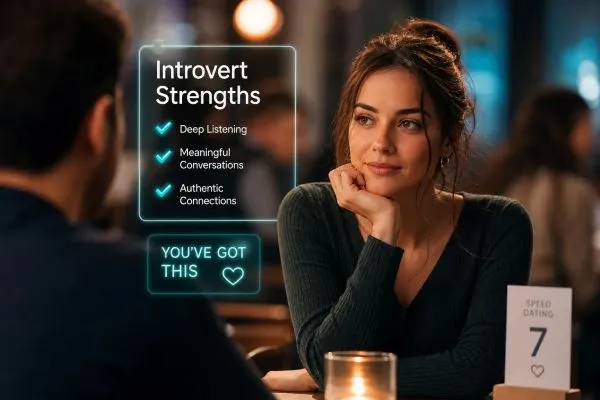
The extrovert across the table might dazzle with energy and quick wit. The introvert makes the other person feel genuinely heard. Deep listening, natural curiosity, and thoughtful responses are not just polite habits, they are the traits that make a brief conversation feel meaningful. In a room full of nervous people trying to make an impression, the person who actually pays attention stands out more than the one who talks the loudest.
Preparation is the introvert's unfair advantage at any social event. The difference between a great night and a draining one often comes down to what happened in the two hours before you arrived. Three areas matter most: physical energy, mental warm-up, and logistical comfort.
Caffeine and a rushed drive across town is the worst pre-event ritual for an introvert. It spikes cortisol before you've even walked in the door. Instead, eat a light meal beforehand so you're not distracted by hunger, skip the extra coffee, and give yourself ten minutes of quiet before you leave. A short playlist that puts you in a calm, confident headspace helps more than people expect. Arriving a few minutes early to get your bearings before the crowd fills in is one of the most underrated moves in social preparation.
Many organizers, including Calgary Speed Dating, send participants a pre-event email with tips, venue details, and a reminder of what to expect. For introverts, this is genuinely useful: it gives you a mental map of the evening so nothing at the venue feels surprising. If you receive one, read it the morning of the event, not five minutes before you walk in. Review the format, note the venue address, and use it as a chance to run through your conversation starters one more time. Preparation isn't anxiety, it's strategy.
The goal is not to come up with clever lines. The goal is to ask questions that invite stories, because stories are where real connection happens. A question that can be answered with "yes" or "no" is a dead end. A question that opens a window into someone's life is a conversation.
Pick three or four from this list that feel natural to your personality. You don't need all of them, and you don't need to use them in order. They're entry points, not scripts.
"What's one thing on your bucket list you haven't told many people about?"
"If you had a podcast, what would it be about?"
"What's the most unexpected thing you've done recently?"
"Any hidden gems in the city you've discovered lately? Cafes, parks, spots off the usual path?"
"What could you talk about for half an hour without any preparation?"
"What's something you've always wanted to learn or try but haven't yet?"
"How do you recharge after a long week?"
"What's a small thing that genuinely made your day recently?"
If nerves are highest in the first round, start with a simple observation about your surroundings instead. Something like, "I've never been to this venue before, have you? What do you think of the vibe?" takes zero preparation and feels completely natural.
Once someone answers your opening question, most people nod and move to the next question. Introverts can do something better: follow up with "how" or "why." The question "how did you end up getting into that?" takes any short answer and opens it into a full story. It signals genuine curiosity without feeling like an interrogation, and it lets the other person do what most people love to do, talk about something they actually care about. This is where your natural listening instinct does the heavy lifting.
Depending on the event format and group size, speed dating can involve anywhere from six to fifteen or more individual rounds in a single evening. For introverts, this is where events can start to feel like a grind if there's no reset strategy in place. The good news is that with two simple techniques, you can stay present and engaged all the way through the final round.
When the host signals the end of a round, take one slow exhale through your mouth before the next person sits down. Let your shoulders drop. Briefly write one word or a short note about the person you just spoke with, this gives your brain permission to release that conversation and start fresh. Research on slow exhalation and brief grounding techniques supports this kind of micro-reset as an effective way to manage social fatigue in real time. Even a 20- to 60-second pause between interactions can help you walk into the next round feeling present rather than depleted.
Many speed dating events build a break into the middle of the evening, and for introverts, this is genuinely one of the most valuable parts of the night. Use it deliberately. Get something to eat or drink, step slightly back from the main crowd for a few minutes, and review your notes from the first half. This is not hiding, this is recovery. The break is built into the event design specifically so that everyone, introverts included, arrives at the second half of the night re-energized rather than running on fumes.
Here's what actually drives a strong first impression in a brief interaction: what you wear, how you hold yourself, and whether you are genuinely present. Authenticity outperforms performance every time in this format. Many introverts try to act more extroverted at events and it reads as stiff or rehearsed. The far more effective approach is simply to be the version of yourself that shows up in a good one-on-one conversation: attentive, curious, and unhurried.
Smart-casual is the right level for speed dating: polished enough to signal effort, comfortable enough that you're not distracted by what you're wearing. Style advice for brief social interactions often points to bolder colors and classic palettes as confident choices. One considered detail, a bold earring, a statement watch, a distinctive jacket, often sparks an organic conversation without you having to engineer one. Comfort is not a style compromise; it is what allows your full attention to be on the person across from you.
A few non-verbal signals matter most in brief interactions: sustained (not staring) eye contact, open posture with uncrossed arms, and a subtle lean-in when the other person is speaking. These are not manipulation tactics. They are the physical expression of paying attention, which is something introverts genuinely want to do anyway. In a room full of people managing nerves and performing confidence, someone who is simply, quietly present feels like a relief.
The event ends, your mutual matches come through, and now the real introvert advantage kicks in: deliberate, thoughtful written communication. With a mutual matching system, you're only reaching out to people who already indicated interest in you. The vulnerability of a cold message is gone. What's left is an invitation to continue a conversation that already started well.
Two elements separate a message that gets a reply from one that gets ignored. First, reference something specific from your conversation. Second, suggest one concrete next step with a specific day or place. Here's a simple template that works:
"Hey [Name], really enjoyed our conversation last night. Your take on [specific thing they mentioned] has been stuck in my head. Would you be up for continuing the conversation over coffee? I'm thinking [Thursday/the weekend] at [a specific place nearby]."
It's direct, personal, and gives the other person something real to respond to. Vague messages like "it was so nice meeting you" rarely convert because they don't give the other person anywhere to go.
Send your message within 24 hours of receiving your matches, ideally the same evening or first thing the next morning. In practice, messages sent while the energy of the event is still fresh tend to land far better than those sent two or three days later. Introverts who prefer deliberate, considered communication are naturally suited to this kind of message. You're not being impulsive. You're being intentional, and the person receiving it will feel the difference.
The traits that make you an introvert, the depth, the genuine curiosity, the preference for real conversation over surface-level chat, are not obstacles to succeeding at speed dating. They are exactly what makes a short conversation feel meaningful to the person sitting across from you. Most people at these events are hoping to feel actually seen by someone. You're already wired to do that.
With a solid pre-event routine, a handful of conversation starters that fit your personality, a reset strategy between rounds, and a follow-up message ready to send that same night, introverts aren't just surviving speed dating. They're often the most memorable person in the room.
If speed dating has felt like the wrong format for an introvert, this is what changes that. Calgary Speed Dating offers professionally hosted events built around a structured, low-pressure format that quietly does a lot of the heavy lifting before you even arrive. Head to calgaryspeeddating.com to see what's coming up and grab your spot at the next event. Your conversation starters are ready. The only thing left to do is show up.
