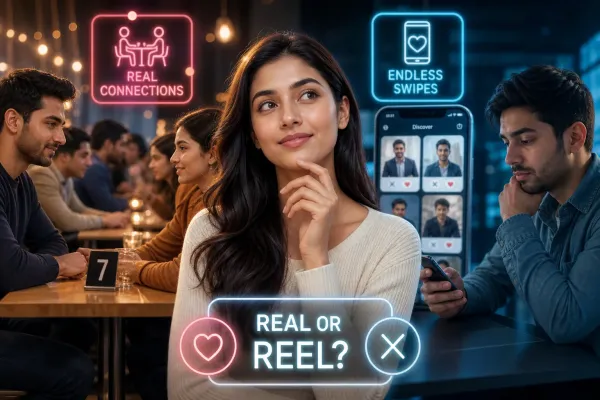
This post is brought to you by Calgaryspeeddating.com - sign up for an event to meet real singles in Calgary.
When weighing speed dating vs dating apps, the evidence points in a clear direction: in-person events tend to produce stronger initial chemistry, more clearly defined match outcomes, and a better return on your time per genuine introduction. The research supports this conclusion, and so do the experiences of many singles who shifted from swiping to showing up. Calgary Speed Dating, which holds a Guinness World Record for the largest speed dating event ever held and reports an organizer-verified 80%+ match rate, illustrates what a well-run in-person event can deliver.
Dating apps feel like the logical, modern default. Feeling efficient and being efficient are two different things, though. This article breaks down the real numbers on both sides so you can make a clear-eyed decision about where your dating energy actually belongs.
The price of a dating app subscription looks modest on paper. A basic paid tier on Tinder, Bumble, or Hinge runs roughly $10 to $35 per month in Canada, but entry-level plans strip out the features that actually improve your results. Add boosts, visibility upgrades, and extended filters and you can easily land north of $100 monthly. The bigger cost, though, is time. Active app users average between two and six hours per week swiping, messaging, and waiting for conversations that often go nowhere, a figure drawn from multiple app-usage surveys, though results vary by platform and individual intensity.
A speed dating event in Calgary typically costs between $40 and $80 including GST for a single evening, based on current Calgary Speed Dating pricing. For that, you walk away with 10 to 15 real conversations with real people who showed up for the same reason you did. There is no ghost-messaging stage, no waiting days for a reply, and in most cases no uncertainty about whether someone's photos reflect reality, though it's worth noting that contact and follow-up after events still involve the usual social variables.
| Factor | Dating app (paid) | Speed dating event |
|---|---|---|
| Monthly cost (Canada) | $10–$100+ | $25–$80 per event |
| Weekly time commitment | 2–6 hours per week | 2–3 hours once a month |
| Introductions per session | Low; mostly text exchanges | 10–15 face-to-face conversations |
| Format | Digital, asynchronous | In-person, structured, hosted |
| First date built in? | No; separate step required | Yes; conversation happens at the event |
The table makes the unit economics clear. A subscription is cheaper to start, but once you factor in both time and money, the cost per meaningful introduction is not as favorable as it first appears. For many singles, a single well-run speed dating event can be more time-efficient for introductions than weeks of active swiping, depending on user intensity and local app success rates, your mileage will vary.
The research exists, but it does not tell a clean story. A 2025 survey of dating app users found that 65.9% had gone on a date with an app match at some point in their lives. That sounds promising until you realize it is a lifetime self-report across all app use, not the probability that any individual match leads to a date. The actual per-match conversion rate is far lower and far harder to measure.
Speed dating research offers sharper data. A longitudinal study by Asendorpf, Penke, and Back followed 382 people after an in-person speed dating event for up to one year. Among mutual matches, 49.2% met in person again within that period. One year later, 4.4% reported a romantic relationship. The denominator is clearly defined: one event, one night, one pool of real people.
Apps carry a well-documented funnel problem. A large volume of matches carry little commitment behind them. Conversations stall, matches go cold, and the entire process loops back to swiping. Speed dating compresses the earlier stages of that funnel by producing a face-to-face conversation before anyone exchanges a phone number, the chemistry question gets a partial answer the same evening. Later steps, like follow-up dates and relationship formation, still require investment, but the starting point is more concrete.
About 78% of dating app users report feeling emotionally or mentally drained from online dating, according to a 2025 Forbes Health survey (figures drawn from a U.S. sample; Canadian-specific data is more limited). That is not a quirk of individual users. It is a signal that the format has a structural problem worth taking seriously.
A major review by Finkel, Eastwick, Karney, Reis, and Sprecher found no compelling evidence that dating-site algorithms produce better romantic outcomes than other ways of pairing people. The researchers argued that chemistry depends on interactional qualities that profiles cannot capture, things like how someone responds to an unexpected question or whether the conversational rhythm between two people feels natural. This was not a minor finding. It was a direct challenge to the core premise of algorithm-based matching.
A separate speed-dating study of roughly 350 participants reinforced the conclusion. Personality and preference questionnaires filled out before the event did not meaningfully predict who found whom attractive. Algorithmic pairings performed no better than chance for initial attraction. The people who clicked did so in real time, not on paper.
Apps also create an idealization problem. Online communication can build attraction before a first meeting, but it can also create an impression the actual person does not match. One study found that romantic attraction sometimes declined after a first in-person meeting when the reality contradicted the impression formed through messaging beforehand. Meeting in person reduces that specific dynamic considerably, you meet the person rather than a curated version of them assembled over weeks of text. It is worth acknowledging that surprises and disappointment can still occur in any first meeting, but the expectation gap tends to be smaller.
Swiping harder is not the same as dating smarter. The algorithm optimizes for what it can see: age, location, photos, a few lines of text. It has no access to the thing that actually determines whether two people will connect.
A 2023 Pew Research survey found that 48% of dating app users had experienced at least one form of unwanted behavior. Among women under 50, 56% had received unsolicited explicit content and 43% had experienced continued contact after rejecting someone. Separately, 52% of online dating users said they believed they had encountered someone trying to scam them. These are not edge cases. They reflect the structural reality of an environment built on low-friction anonymity.
Dating apps collect profile data, location information, messaging histories, and behavioral patterns. Researchers have specifically flagged location sharing as a risk, given its potential to facilitate unwanted encounters. One Australian study found that 34% of surveyed app users reported experiencing sexual harassment, aggression, or violence in person from someone met through a dating platform, a sobering figure, though methodology and sample size should be considered when interpreting it.
In-person speed dating events carry a different risk profile. Reputable organizers in Canada address in-person risk directly: photo ID verification at check-in, trained staff present throughout, and clear conduct policies with private channels for reporting concerns. Calgary Speed Dating hosts events in public venues with staff on-site all evening. The structured, timed format also limits the conditions under which sustained one-on-one pressure can develop. It is worth noting that organizers do collect attendance and contact information, so it is reasonable to ask any organizer about their data practices before signing up.
Calgary Speed Dating reports an organizer-verified 80%+ match rate across its events. For context, a Canadian man on Tinder can reasonably expect a match rate of around 1% to 5% per right-swipe, with roughly one in seven Hinge matches leading to a first date based on the most defensible public estimates. These figures measure different things, event-level mutual interest versus per-swipe app conversion, so a strict apples-to-apples comparison is not possible. Still, the gap between those benchmarks and what well-run speed dating events report is substantial.
The format's core advantage comes down to information quality. Within a single evening, you have already seen how someone carries themselves, how they respond under mild pressure, whether the rhythm of a conversation feels natural. That data is worth more than a well-crafted bio and five photos. No algorithm can collect it for you in advance.
Cathy Scrimshaw, founder of Calgary Speed Dating, has observed a consistent pattern after 18 years of running events in Calgary, including the Guinness World Record event that drew 651 attendees on February 14, 2014. In her experience, the connections that turn into something real almost always trace back to a single evening that felt low-stakes and surprisingly enjoyable. The format's built-in time limit removes the pressure of a traditional first date and creates space for genuine interest to surface.
Speed dating is a particularly strong fit for busy professionals who need a scheduled, single-evening investment. It also works well for singles re-entering dating after a long relationship who find apps impersonal or overwhelming, and for anyone who has hit the wall that 78% of app users describe, the fatigue that comes from a system designed to generate volume rather than connection.
When comparing speed dating vs dating apps, the picture that emerges from the research is nuanced but directional. Available evidence often favors in-person events for initial chemistry and event-level conversion, and apps carry well-documented structural problems around engagement fatigue and safety. Head-to-head evidence across the full relationship funnel is more limited, but the case for showing up in person is hard to dismiss.
Apps offer volume. Speed dating delivers connection. If you are in Calgary and ready to stop managing an inbox full of stalled conversations, Calgary Speed Dating's monthly events offer a direct alternative: an organizer-reported 80%+ match rate, nearly two decades of results, organizer-reported success stories including marriages, and a format built around human connection rather than algorithmic convenience.
Join the interest list to be notified when the next Calgary speed dating event opens. The evening is short. The connections can last.
You can expect about 10–15 face-to-face conversations in a single speed dating evening. That typically happens in under three hours, so the event compresses many introductions into one efficient session.
Calgary Speed Dating reports an organizer-verified 80%+ match rate and holds a Guinness World Record for the largest speed dating event. The organizer has run events in Calgary for nearly two decades and cites organizer-reported success stories, including marriages, as part of that track record.
Speed dating is especially well suited to busy professionals, people re-entering dating after a long relationship, and anyone fatigued by high-volume swiping. The format's scheduled, single-evening investment and structured, low-stakes interactions help those groups get meaningful introductions without prolonged messaging.
Active app users average between 2–6 hours per week swiping, messaging, and waiting for conversations. By contrast, a speed dating evening usually requires 2–3 hours once a month to yield 10–15 real conversations.
