This post is brought to you by Calgaryspeeddating.com - sign up for an event to meet real singles in Calgary.
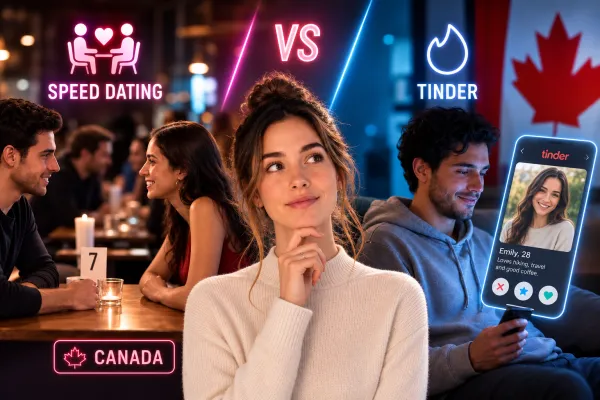
The speed dating vs Tinder debate in Canada has a clearer answer in 2026 than most people want to admit. Seventy-eight percent of Canadian app users report burnout (according to Forbes Health survey data), yet most keep swiping because they've never seriously tried the alternative. That's not a criticism. It's what happens when one option dominates the conversation for a decade and the other gets dismissed as outdated. Calgary Speed Dating has been running structured, in-person events for over 25 years, long enough to have real data on what actually connects people. This piece compares speed dating vs Tinder in Canada across four dimensions: cost, match quality, time, and emotional experience. The comparison draws on separate bodies of evidence, speed dating operator data, app engagement studies, and relationship satisfaction research, rather than a single head-to-head study, because no peer-reviewed direct comparison of the two formats currently exists. The numbers, however, point in a consistent direction.
Tinder Gold runs $39.99 per month in Canada. Tinder Platinum is $53.99 per month. As of mid-2026, Tinder officially eliminated its age-based pricing tiers globally, so the penalty that once charged users aged 30 to 49 up to six times more than younger users no longer applies. That's a recent change, but it doesn't fix the core problem. Boosts, Super Likes, and additional premium features stack on top of your base subscription. A full Tinder experience runs $50 to $80 or more per month, with no structural guarantee of a single in-person conversation. You're not buying a result. You're buying access to the possibility of a result, month after month, renewing automatically with no defined endpoint, a billing pattern Canadian consumer advocates have flagged repeatedly in app store complaints.
Most Canadian speed dating events run $25 to $50. Calgary Speed Dating charges $80 per event, which sounds like more until you run the actual math. According to Calgary Speed Dating's event listings, that ticket covers 15 to 17 face-to-face conversations in a single evening, with complimentary appetizers served midway through. Divide $80 by 16 people and you're paying $5 per real conversation. Compare that to a Tinder Platinum subscription at $53.99 per month, which buys you no guaranteed in-person meetings at all. The cost-per-outcome comparison isn't close, and most people never think to frame it that way.
Canadian Tinder's user base is approximately 82.9% male and 17.1% female, a structural imbalance that shapes every interaction on the platform before you've typed a single message. Men receive roughly one match per 140 swipes. Globally, approximately 86% of all matches never result in a first date (based on aggregate app engagement data). Add fake profiles, inactive accounts, and the endemic ghosting that most Tinder users now treat as routine, and the pipeline from swipe to date leaks at every stage.
The research on long-term outcomes adds another layer. A 2024 study published in Computers in Human Behavior found that couples who met via apps report lower marital stability than those who met offline. More recent 2025 data across 50 countries showed that people who met in person reported higher relationship satisfaction and greater intensity of love across intimacy, passion, and commitment.
Calgary Speed Dating reports an 80%+ mutual match rate across its events, a figure the organizer attributes to 25+ years of refining the structured in-person format. Whether measured against the industry's own benchmarks or against Tinder's 86% match-to-no-date drop-off, in-person formats generate a fundamentally different signal. When two people sit across from each other for a few minutes, chemistry, tone, humor, and presence are all visible in ways a profile photo and bio cannot approximate. Calgary Speed Dating's mutual interest system only notifies participants when both parties indicate interest, so there's no two-week silence followed by being left on read. You either matched or you didn't, and you move forward from there. It's worth noting that high initial match rates at speed dating events don't automatically translate to long-term relationships, but as a starting point for genuine in-person connection, the format outperforms the app model on the immediate outcomes that actually matter.
One commonly cited estimate puts the average active Tinder user at roughly 35 minutes of daily app use across four sessions, though engagement estimates vary across sources, with some studies reporting figures as high as 90 minutes per day. Even at the conservative end, that adds up to more than 17 hours of swiping, messaging, and waiting over a single month, with no structured endpoint and no accountability built in. Behavioral research on large-choice environments, including Barry Schwartz's foundational work on the paradox of choice, consistently shows that evaluating more options pushes decision-making toward superficial signals rather than deeper judgment. Tinder is optimized for engagement, not for outcomes. The time you're spending is the point of the product, not a side effect of it.
One speed dating event runs two to three hours. In that time, you have structured conversations with 15 to 17 people. Every conversation has a clear, time-limited purpose, which removes the ambient anxiety of wondering whether anything will go anywhere. When the evening ends, you submit your preferences and receive match notifications only when interest is mutual. The process produces a concrete outcome in a single sitting. Contrast that with 17-plus hours of monthly app use spread across hundreds of fragmented sessions, and the efficiency argument becomes hard to dismiss.
Seventy-eight percent of Canadian dating app users report burnout. Among Gen Z, roughly sixty percent reach it within just a few months of starting, according to Forbes Health survey data. The mechanics that produce this aren't complicated. Ghosting removes accountability. Volume creates decision fatigue. Research also documents that Tinder's algorithm produces uneven visibility across demographic groups, with Black women and Asian men consistently receiving fewer matches and lower platform exposure. That's not a bug in an otherwise fair system. It's a documented, structural outcome that carries real emotional weight over time. The cumulative effect isn't just frustration, it's a quiet erosion of trust that makes genuine connection feel less possible the longer you stay on the app.
In-person events change the dynamic at the structural level. Everyone in the room paid to be there and showed up. That self-selection filters out the low-effort behavior that defines app culture before the first conversation even starts. You're reading body language, tone, and humor in real time, fundamentally different signals than a curated profile. The shared intent is unambiguous by design: nobody is there by accident, and nobody is hedging their participation behind a screen. That structural clarity is what speed dating participants consistently describe as the format's most immediate difference from app dating, and it's not a subjective impression. It's the logical result of how the format is built.
Tinder works best for singles in the 18 to 28 range who are comfortable with ambiguous, low-commitment interaction. If you've recently relocated and want a casual read on the local social landscape, it has some utility. It also performs better for people with strong photography skills and confident written communication, because those two factors drive most of the variation in outcomes on the platform. Outside of those conditions, Tinder's structural limitations start to outweigh its convenience fairly quickly.
Anyone 30 and up who is re-entering dating after a relationship, or who has simply grown tired of app culture, will find the speed dating format more efficient on every dimension covered in this article. Introverts often find it less intimidating than bar scenes or cold approaches because the structure removes the pressure of initiating. There's a format to follow and a time limit on each conversation, which actually makes things easier for quieter people, not harder. Calgary Speed Dating runs age-specific events for singles from their 20s through their 70s, so the format isn't locked to one demographic. For anyone not quite ready for speed dating, the Singles Games Night option offers a lower-pressure entry point where you can meet people in a social setting without the one-on-one rotation format.
If you've been using a dating app for more than three months without a meaningful in-person connection, that's your signal. Not to try harder, but to try differently. The format isn't working. In Calgary and surrounding areas, Airdrie, Cochrane, Okotoks, and Chestermere, Calgary Speed Dating has been running in-person matchmaking events on a regular schedule for over 25 years. The decision isn't about technology versus tradition. It's about which format produces real outcomes for you specifically, and the data in this article makes that comparison straightforward.
calgaryspeeddating.com hosts monthly events at popular Calgary venues, and events regularly fill weeks in advance, so registering early matters. Based on current event listings, the $80 ticket works out to $4 to $5 per genuine conversation when you account for the 15 to 17 people you'll actually meet, with appetizers included midway through the evening. If you want to ease in, the Singles Games Night format lets you meet people in a social, collaborative setting before committing to the speed dating structure.
For Canadian singles seriously looking, the speed dating vs Tinder comparison has a clear answer when you run the actual numbers. Cost per interaction: $4 to $5 per real conversation versus $53.99 per month with no guaranteed meetings. Match quality: an 80%+ mutual match rate at structured events versus an 86% global drop-off between match and first date on apps. Time: one structured evening versus 17-plus hours per month of fragmented swiping. Emotional experience: accountability and shared intent versus ghosting and algorithm fatigue. None of those comparisons are close. You already know what three more months on Tinder looks like, it looks exactly like the last three months. One speed dating evening is something you don't yet know. That asymmetry alone is worth acting on.
