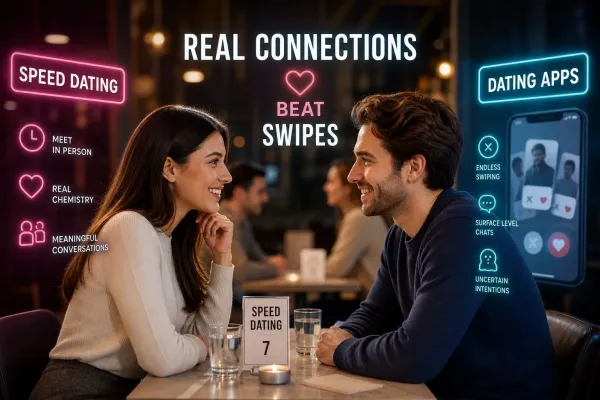
This post is brought to you by Calgaryspeeddating.com - sign up for an event to meet real singles in Calgary.
If you've been asking yourself why is speed dating better than apps, the answer comes down to one thing: face-to-face chemistry that no algorithm can replicate. In-person events produce roughly 20–30 mutual matches per 100 conversations. Dating apps, by comparison, produce about 1 compatible match per 100 swipes. That gap is not subtle. According to the 2024 Forbes Health/OnePoll survey of 1,000 app users, 78% felt emotionally or mentally exhausted from app dating, the top reason being a simple failure to find meaningful connection. Meanwhile, professionally run in-person events like Calgary Speed Dating have maintained an 80%+ match rate across 18+ years of structured events, according to the organizer. This article compares both formats across match rates, authenticity, efficiency, and cost, then gives you concrete tactics to get the most out of your first event.
The 2024 Forbes Health/OnePoll survey of 1,000 app users found that 78% felt emotionally, mentally, or physically exhausted at least sometimes, a figure that skewed toward 80% among women and 74% among men. Keep in mind this was a U.S.-based sample, so results for Canadian users may differ, though the pattern is consistent with broader reports of dating app burnout. The leading driver was not finding a meaningful connection, cited by 40% of respondents. Disappointment with people encountered followed at 35%, and 38% reported being catfished or encountering fake profiles.
These are not isolated complaints. They form a reinforcing cycle: choice overload leads to repetitive effort, weak interactions, rejection, and distrust, then deleting the app, then reinstalling it a few weeks later. Many researchers and platform critics argue that app design prioritizes re-engagement over relationships, with the promise of the next great match keeping users hooked even as the experience drains them. A 2025 panel study of 521 app users found that feeling unsuccessful on apps was directly associated with loneliness and lower well-being.
The accountability gap makes everything worse. Ghosting has no consequences on an app. Misrepresented profiles are common and rarely checked. There is no social cost for poor behavior when the other person is a stranger on a screen. In-person events change that dynamic entirely. Everyone in the room is physically present, has paid to be there, and is accountable to a shared environment with other real people. That shift in accountability changes the quality of every conversation in the room.
Across multiple academic studies of speed dating events, roughly 40–60% of attendees report at least one mutual match per event, averaging about 2.5 matches from 10–12 conversations. On a per-interaction basis, that translates to roughly 20–30 matches per 100 conversations. Dating apps produce approximately 1 compatible match per 100 swipes, though the definition of "match" varies widely by platform, user demographics, and whether the metric means a mutual like, a message exchange, or an actual in-person date. Even accounting for those variables, the comparison isn't close. Apps give you volume; speed dating gives you signal.
Calgary Speed Dating offers a useful real-world reference point. With 18+ years running structured in-person events in Calgary, a history the organizer documents, and a self-reported 80%+ match rate, it reflects what a well-organized format can produce. The Guinness World Record for the largest speed dating event ever held (651 attendees on February 14, 2014) illustrates how seriously experienced organizers can take the format, though a single large event doesn't predict typical match outcomes. Execution still matters enormously.
A mutual "yes" at a speed dating event is not a relationship. A realistic expectation is one to two actual dates from several matches, with a low-single-digit percentage chance of a sustained relationship per event. The honest argument for speed dating is not that it guarantees a partner. It is that it produces faster, higher-quality feedback than weeks of messaging on an app. You find out in five minutes what months of swiping may never tell you.
In five minutes of face-to-face conversation, you process body language, eye contact, vocal tone, humor, and energy. Research in interpersonal attraction consistently shows that these nonverbal cues play a significant role in how quickly people assess compatibility, cues that profiles and text threads can only approximate at best. The thing people are actually looking for, which is a felt sense of connection with another person, doesn't reduce neatly to a swipe algorithm.
Dating app profiles are managed identities. People select their best photos, craft their bios, and present a filtered version of themselves. In a speed dating room, you get the actual person within the first 90 seconds. Posture, eye contact, nervous energy, warmth, all of it lands immediately. You are not reacting to a curated presentation; you are reacting to someone real. That is either uncomfortable or clarifying, but either way, it is honest.
How someone speaks tells you things a bio never will. Their pace, their pauses, the way they laugh, whether they actually listen, these signals are invisible on an app and unmistakable in person. The timed format also helps people who find unstructured social settings overwhelming. Speed dating removes the burden of deciding how long to talk, when to approach someone, or how to exit a conversation. The structure handles all of that, leaving the chemistry to emerge naturally. For introverts, busy professionals, and singles re-entering the dating scene after time away, that structure is genuinely valuable.
| Factor | Speed dating (monthly event) | Paid dating app (monthly) |
|---|---|---|
| Typical cost (Canada) | C$40–C$60 per event | C$20–C$45 per month |
| Time investment | ~90 minutes per event | Several hours per week |
| Conversations per session | 10–15 face-to-face | Variable; often zero in-person |
| Match rate per interaction | ~20–30% | ~1% |
| Profile verification | Present in person | Minimal; catfishing common |
| Results turnaround | 24–72 hours | Ongoing; often no closure |
| Six-month total cost | C$180–C$360 | C$120–C$270 |
Speed dating costs roughly C$60–C$90 more over six months than a mid-priced app subscription. But that calculation ignores what you are actually buying. A single event gives you 10–15 face-to-face conversations with pre-screened, single, age-appropriate people who showed up specifically to meet someone. A month of app use often produces no in-person meetings at all, while consuming several hours each week in cognitive load: managing conversations, rescheduling, processing ghosting, and starting over.
For busy professionals and single parents, the efficiency argument is the whole argument. Speed dating concentrates all of that effort into one focused evening. Results arrive within 24–72 hours. You build genuine in-person social confidence with every event you attend, a compounding benefit that swiping never produces.
Speed dating is a strong fit for a few specific groups. Busy professionals who have little time for traditional dating. Introverts who benefit from a structured format that removes awkward entry and exit points. Singles in their 40s and 50s who find apps alienating after re-entering the dating scene. Single parents who need to make every evening count. Anyone who has hit a wall with app-based dating and wants something that works differently. Each of these groups benefits from the format's efficiency and the accountability that comes with being in the same room as other real people.
It is not for everyone. If you live far from event venues, logistics can be a barrier. Smaller events may not have the demographic balance you need; age ratios and gender parity vary by organizer and city. You also get one shot to make an impression in five minutes, which some people find stressful rather than liberating. And like any format, it works better with repeated attendance. One event is not a guarantee.
A simple frame for deciding: if your main complaint about apps is lack of real connection rather than lack of volume, speed dating is worth trying. If you have never had trouble getting meaningful dates through apps, you probably do not need it. But if you are feeling the dating app burnout that 78% of app users in the Forbes survey reported, a single well-organized in-person event will tell you more in 90 minutes than months of swiping.
Before you walk in, research the organizer's format, match rules, and code of conduct. Tell a friend where you are going and when you expect to be back. Arrive knowing what you genuinely want to learn about someone in five minutes, not a script, but a few honest questions. Dress in a way that feels like you.
During the event, lead with curiosity rather than performance. The people who do well at speed dating ask real questions and actually listen. You are not auditioning; you are having a conversation. A simple rhythm helps: ask an open question, follow up on what they say, then offer something related from your own life before moving on. Avoid rapid-fire fact-checking ("What do you do? Where do you live?") without any reciprocal disclosure. Mark your preferences honestly rather than optimistically. A genuine match beats a polite yes every time.
When your results arrive, follow up within 48 hours. Keep the first message short and specific, reference something from your actual conversation. Skip the formal date proposal right away; start with a low-stakes check-in instead. If an event produces no matches, go back. Repeated attendance at well-targeted events moves the needle. The difference from repeated app use is this: each event builds real social confidence rather than just adding more swipes to a depleted emotional account.
Speed dating is not a magic solution. Neither are dating apps. But the comparison is clearer than most people expect. Apps offer scale and convenience while regularly delivering swipe fatigue, disappointment, and chemistry-free interactions. Speed dating offers a compressed, accountable, in-person format where real compatibility either shows up or it doesn't.
You find out fast.
The 80%+ match rate that Calgary Speed Dating reports having sustained over 18 years reflects what happens when the format is run well and the right people show up. Why is speed dating better than apps for people who are serious about meeting someone? Because a five-minute conversation delivers feedback that a thousand swipes cannot. Stop treating your dating life like a browsing session. Go somewhere, be present, and let the room do what an algorithm never will.
Get on the interest list at Calgary Speed Dating and see what real in-person matchmaking feels like. One evening is all the data you need.
You will typically hear results within 24–72 hours. I report that face-to-face events produce rapid turnaround compared with ongoing app use, so you get closure and next steps much faster than with swiping.
Speed dating costs roughly C$60–C$90 more over six months than a mid-priced app subscription. I point out that this extra cost buys concentrated, 10–15 face-to-face conversations and faster results rather than ongoing hours of swiping and messaging.
Keep the first message short, specific, and reference something from your actual conversation. I advise a low-stakes check-in rather than an immediate formal date proposal, and to follow up within 48 hours to improve your chances.
A mutual "yes" at an event does not guarantee a relationship; expect one to two actual dates from several matches and a low-single-digit chance of a sustained relationship per event. I emphasize that the real benefit is faster, higher-quality feedback rather than a promise of a partner.
