This post is brought to you by Calgaryspeeddating.com - sign up for an event to meet real singles in Calgary.
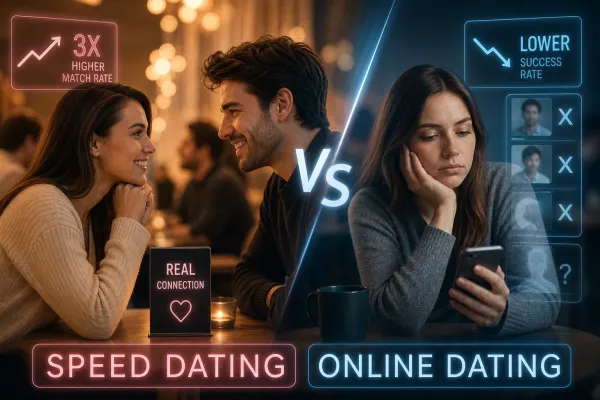
Why is speed dating better than online dating? For most singles, it comes down to three things: chemistry you can feel, time you don't waste, and a format built to actually produce results. Calgary Speed Dating, which has been running in-person singles events for over 18 years, reports an organizer-tracked 80%+ match rate per event. The average dating app user, by comparison, spends roughly 51 minutes a day swiping and messaging before meeting anyone face to face, and industry estimates suggest only about 17% of app matches ever become an in-person first date, a figure that varies by platform, gender, and user activity.
This article breaks down exactly why speed dating works better for most singles, where the data supports that claim, and when online dating still makes sense. No cheerleading for one side. Just an honest look at what the research shows and what 18 years of real-world events have demonstrated.
Most people measure dating success by relationships formed, not by app downloads or event tickets sold. The criteria that matter are chemistry on first contact, time invested before a real conversation happens, and the quality of the eventual match. Any honest comparison between speed dating and online dating has to start there, not with which format is more popular or more convenient.
The research here is messier than it looks. Studies on speed dating and studies on online dating use completely different denominators. Speed dating research tracks event-level outcomes: who matched, who followed up, who dated. Online dating research tracks cumulative outcomes across months or years of app use. One 2025 study of 270 app users found that 41.1% entered a serious relationship through an app, which sounds impressive until you realize that result accumulated over an extended period of sustained use, not a single evening. Comparing those numbers directly would be misleading, and this article won't pretend otherwise.
The three lenses worth using are chemistry, time efficiency, and match quality. Each section below addresses one directly, so the argument builds rather than just asserts.
Interpersonal attraction research consistently shows that chemistry is interactional, not trait-based. It emerges from mutual responsiveness, shared timing, eye contact, vocal tone, and physical presence, signals that profiles and text messaging cannot transmit. A widely cited line of behavioral research found participants showed greater neural arousal and sustained attention when interacting with real faces versus digital ones, which tracks with what anyone who has had a surprisingly great in-person conversation already knows intuitively.
Nonverbal synchrony is one of the strongest early predictors of rapport. When two people naturally coordinate their gaze, facial expressions, and conversational rhythm, they tend to like each other more. Speed dating puts people in the same room so this synchrony can happen. Asynchronous text messaging lacks most of those cues, and extended messaging before meeting can actually create false expectations in both directions. You either idealize someone you've never met or dismiss them before you've ever felt how a conversation with them actually flows.
There's also what attendees at speed dating events describe as the "someone I'd have swiped left on" phenomenon. A recurring theme in testimonials is meeting someone you would have filtered out based on a photo or a profile blurb, only to find genuine connection in person. This is not a flaw in the format. It's one of its most valuable features, it forces the kind of openness that algorithms actively suppress by feeding you only what you already think you want.
Vocal warmth, nervous energy, the way someone listens, none of it survives a profile. A few minutes of real conversation often tells you more than a week of texting. That's the core case for why speed dating is better than online dating when chemistry is what you're actually after.
The average dating app user spends about 51 minutes per day swiping and messaging. A large proportion of that time leads nowhere: matches go cold, conversations stall, or one party ghosts without explanation. Industry estimates suggest only around 17% of app matches ever result in a face-to-face first date, meaning the pipeline from match to first meeting is long, leaky, and unpredictable. That figure is an approximation drawn from app-specific data and varies substantially by platform and user behavior.
A well-run speed dating event runs about two hours. In that time, you have structured conversations with 9 to 15 people who showed up, paid to be there, and are actively looking for a connection. The mutual interest check at the end of the evening gives you immediate feedback, faster than many app exchanges that stretch across days of messaging. You leave knowing whether anyone felt the same pull you did, rather than refreshing your notifications and wondering.
App culture also creates what researchers call choice overload. When options feel infinite, committing to any of them becomes harder. Speed dating's bounded format, a fixed group, a single evening, a clear result, removes that trap. It gives you enough choice without paralyzing you with too much. That's not a limitation of the format. That's a deliberate structural advantage.
| Metric | Speed dating (well-run events) | Dating apps (self-reported, cumulative) |
|---|---|---|
| People met in one session | 9 to 15 in a single evening | Varies; no guaranteed in-person meeting |
| Mutual match rate | ~86% receive at least one mutual match per event | ~17% of matches convert to a first date (approximate, varies by app) |
| Serious relationship formation | Real outcomes documented; harder to isolate per event | ~41.1% over extended app use (months to years) |
| Time investment to first real conversation | Same evening | Days to weeks of messaging for many users |
Calgary Speed Dating's organizer-reported 80%+ match rate reflects consistent outcomes across hundreds of events over 18 years of monthly programming. The organization also holds the Guinness World Record for the largest speed dating event ever held, with 651 attendees on February 14, 2014, an event that required matching infrastructure and outcome tracking at a scale most organizers never reach. Organizers report that some matches have led to long-term relationships and marriages: matches that became dates, dates that became relationships, relationships that became lifelong partnerships.
In a speed dating context, a match means two people independently marked each other as a "yes" at the end of the evening. No algorithm weighting, no sponsored profile surfacing, no AI-curated feed. Two people who both chose each other after a real conversation. That's a more transparent signal than a mutual right-swipe on a photo.
Some singles are genuinely better suited to this format than others. Busy professionals who want efficient use of their evenings thrive here, because one night produces more genuine leads than a month of half-hearted swiping. Singles in their 40s and 50s who find app culture alienating consistently report that the structured, respectful environment of a well-run event feels far more comfortable. Introverts, perhaps surprisingly, often do well in the short, timed, one-on-one format. It removes the noise of unstructured social settings and gives them a clear conversational container to work within.
Single parents who need an organized evening that produces real results, rather than months of low-grade messaging leading nowhere, also find the format suits their limited time. Anyone who has burned out on swiping knows the feeling. Meeting real people in a real room is a relief, not a chore. Calgary Speed Dating's events draw singles from their late 20s through their 60s, across professional backgrounds and relationship goals. Organizers aim for diverse attendance, so most people walking in will find a room that reflects a broad cross-section of Calgary's dating pool.
Online dating still wins on geographic flexibility, scheduling convenience, and pool size. If you live in a small town, travel constantly, or have a very specific compatibility criterion that filters most people out, apps give you access to a volume of potential partners that no single event can match. The honest question to ask yourself: is your main frustration finding people to talk to, or feeling a spark with the ones you do talk to? If it's the former, apps have more volume. If it's the latter, speed dating is built for exactly that problem.
Speed dating events draw from a smaller pool than apps, and if you live outside a major city, finding events that match your age range and relationship goals is harder. First-impression bias is real: a few minutes of conversation can favor people who are naturally extroverted and quick to connect, which means quieter, slower-to-warm personalities may underperform relative to their actual compatibility. And if the event is poorly organized, the gender ratio is off, or attendance is sparse, the format breaks down entirely. These are genuine constraints, not excuses.
Most of speed dating's limitations are organizational rather than structural, though. A well-run event with curated age ranges, balanced attendance, and an experienced host who manages the room changes the experience entirely. This is why experience and track record matter more in speed dating than in almost any other dating format. Eighteen-plus years of running events in Calgary isn't just a tenure badge. It's the accumulated knowledge of what makes a room actually produce matches versus what just produces an awkward evening everyone wants to forget.
Speed dating is not magic, and it is not for everyone. But for singles frustrated by the gap between online chemistry and in-person reality, it solves a specific problem: it puts you in a room with real people who genuinely want to meet someone, and it gives you enough time to feel something real before the evening ends.
The evidence points in a consistent direction. Face-to-face conversation tends to produce faster and more grounded chemistry signals than a profile or message thread, though it's worth noting that research finds no meaningful difference in long-term relationship satisfaction between couples who met online and those who met in person. The medium matters less for relationship quality than it does for getting to that first real conversation efficiently. That's the case for organized in-person dating events, and why speed dating, done well, continues to produce lasting relationships well into the app era.
If you're in Calgary and want to try it for yourself, monthly events run year-round with an organizer-reported 80%+ match rate and over 18 years of proof behind them. Get in touch with Cathy's team to find out when the next event is scheduled. One evening gives you more real conversations than most people have in a month of swiping, and you'll know the same night whether any of them landed.
A typical speed dating event runs about two hours. In that time participants usually have 9 to 15 structured conversations, allowing multiple real interactions in a single evening.
A match is recorded when two people independently mark each other as a "yes" at the end of the evening. That mutual selection happens after real conversations, with no algorithm weighting or AI curation involved.
You usually know the same night whether anyone felt the same pull you did. Organizers provide mutual-interest feedback at the end of the session, so you leave with immediate results rather than waiting days or weeks.
Yes; organizers report that some matches have led to long-term relationships and marriages. Research also finds no meaningful difference in long-term relationship satisfaction between couples who met online and those who met in person, so meeting format matters most for getting to that first conversation.
Yes; monthly events run year-round in Calgary and the organizer has operated in-person singles events for over 18 years. The organizer-reported match rate across those events is 80%+ per event, and they even hold the Guinness World Record for the largest speed dating event with 651 attendees on February 14, 2014.
