This post is brought to you by Calgaryspeeddating.com - sign up for an event to meet real singles in Calgary.
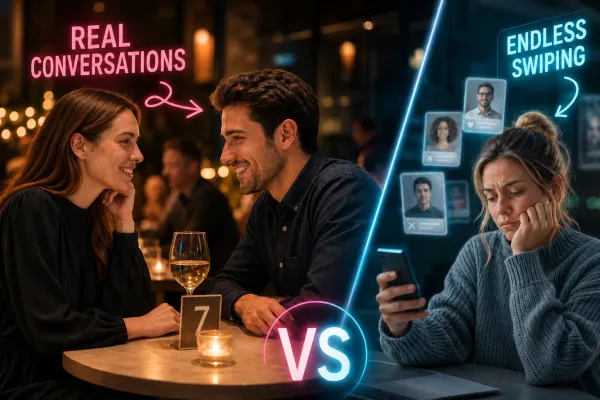
How is speed dating more effective than swiping endlessly on apps? At some point, every online dater has the same quiet moment of clarity. You're sitting on your couch, phone in hand, thumb doing that familiar flicking motion, and you realize you've been at this for six months without a single second date that meant anything. That's not a personal failing. That's a structural problem with the tool you've been using.
The answer, as it turns out, is backed by research, not just vibes. Understanding how is speed dating more effective starts with looking at match rates, in-person chemistry, and the simple math of time spent versus connections made. For an organization like Calgary Speed Dating, running live events in Calgary for over 18 years with an organizer-reported 80%+ match rate, the data is pretty hard to argue with. This article covers what the research actually shows, why in-person chemistry works on a neurological level, and exactly what you can do to get better results at your next live event.
Academic research consistently finds that roughly 60.7% of speed dating participants receive at least one mutual match per event. That number comes from peer-reviewed work, not a marketing brochure. A more recent virtual speed dating study pushed that figure to 83%, with participants averaging just over two matches per evening. At the individual date level, a university-level study tracking 394 dates found a 16.5% mutual match rate per individual conversation, meaningful considering these are five-minute windows.
For long-term relationship outcomes, the honest academic number sits at about 4, 6% of attendees going on to form a sustained romantic relationship, with 6.6% reporting a developing relationship at six weeks. In the context of how the full online dating funnel performs, that figure holds up well.
Tinder-reported data suggests roughly 1.6% of swipes become matches, and less than 1% of those matches become in-person dates. A consumer-insights analysis from dating industry researchers puts the match-to-attended-date rate at 1, 3% of matches. The full swipe-to-relationship funnel runs somewhere between 1 in 100 and 1 in 500 swipes for a first date, and about 1 in 10 to 1 in 100 first dates leads to anything more. Speed dating compresses that entire funnel into a single evening.
Calgary Speed Dating's organizer-reported 80%+ match rate sits well above the 60.7% academic benchmark, and that gap isn't coincidental. Eighteen years of refining the format, professionally organized events with tight age brackets, and a host who genuinely cares about the outcome for every attendee produces results that a loosely organized mixer simply can't replicate. The Guinness World Record event held in February 2014, with 651 attendees, didn't happen by accident. Neither did the marriages that followed.
Your brain is running a surprisingly sophisticated assessment system during every face-to-face conversation, and it works fast. Psychologists call it thin-slicing: the ability to make fairly accurate judgments from very brief encounters. McGill University research with 372 speed-dating participants found that people's impressions of dates' personalities were, on average, fairly accurate. Cross-cultural speed-dating research found observers could identify genuine romantic interest from 10-second clips at 58, 64% accuracy, well above chance. That may not sound impressive until you consider that a profile photo gives your brain almost nothing to work with by comparison.
The reason in-person encounters give the brain better data comes down to the nonverbal cues a screen can't fully transmit. Research points to several clusters that consistently predict romantic attraction in live encounters. Postural expansiveness, an open, forward-leaning body posture, was found in experimental speed-dating research to both predict and causally increase attraction. Sustained eye contact reduces uncertainty and builds intimacy in ways that no amount of texting replicates. And vocal warmth, the softer, lower-pitched speech patterns that emerge naturally in face-to-face settings, carries consistent attraction signals that a voice note simply can't reproduce.
None of these cues are available in text-based messaging, and even video calls capture them only partially. Body sway coupling, which research links to romantic interest beyond physical attractiveness, is only readable when you're in the same room. Postural mirroring, the unconscious signal that two people are genuinely engaged, is invisible on a screen. These aren't minor flourishes to the attraction process. They're core inputs to whether someone feels a pull toward another person.
A 2023 survey by dating app analysts at data firm YPulse found active daters spend an average of six to ten hours per week on dating apps. Six hours a week is roughly an hour a day of swiping, messaging, and navigating conversations that frequently end without ever producing a first date. That time investment, compounded over months, is significant, and the format was designed to keep you on the platform, not to get you off it efficiently.
A single speed dating event typically delivers 10, 20 short dates in two to three hours. At the end of the evening, you note your preferences, and mutual matches receive each other's contact information. Research on date length suggests that 3, 8 minute dates are long enough for thin-slicing and nonverbal reading to occur, but short enough to prevent the awkward extended first date that drags on despite zero chemistry. You know within the first few minutes of meeting someone in person whether there's anything there. Speed dating is simply a structured format that trusts that instinct and lets you apply it to multiple people in one evening.
What this means practically is that one well-organized speed dating event can replace months of app activity for chemistry assessment purposes. Research on thin-slicing and in-person interaction consistently shows that brief face-to-face exchanges surface meaningful compatibility signals faster than extended text-based exchanges, and you won't spend another six months wondering why nothing is converting.
Not all speed dating events produce the same outcomes, and the research is clear on why. Professionally run, age-specific events consistently outperform loosely organized general mixers. Organizer benchmarking data suggests interest-based niche events report approximately 35% higher match rates than general events, and professionals-only formats report roughly 20% higher match rates. Tight age brackets improve the sense of mutual relevance among attendees, which raises match rates across the board.
The most consistent signal across studies isn't one magic age group. It's age alignment: events work better when participants are genuinely close in life stage. That's why structured events with clear age brackets and organized formats outperform the "singles night at a bar" model, where the only thing attendees have in common is being in the same room.
If you're wondering whether this format is for you, consider a few groups that tend to thrive in it. Introverts often do well because the time limit removes the pressure of managing an open-ended conversation indefinitely. Busy professionals tend to find that one structured evening surfaces more useful information than months of messaging. People re-entering dating after a long relationship or divorce often feel more at home in a face-to-face setting than navigating an algorithm. And anyone who has experienced app burnout tends to find the format refreshingly efficient.
Someone who needs a long warm-up period may want to manage expectations for a first event, but the format rewards authenticity in ways that a curated profile simply cannot.
The conversation tactics that actually work in a four-to-six minute window share one thing in common: they invite a story. Favor open-ended, story-inviting questions over questions that produce a one-word answer. "What's the most interesting thing you've done in the last year?" works far better than "Do you travel much?" "What's something most people don't know about you?" opens a door that "What do you do for work?" doesn't. Each question-and-answer exchange should run under 60 seconds, which leaves room for three to four genuine exchanges per date.
The follow-up question matters as much as the opening one. After every main question, add one curious follow-up: "How did that happen?" or "What did you do next?" That's the difference between a real conversation and a checklist, and it's what people actually remember afterward. It also gives you something specific to reference later, which brings us to follow-up procedure.
Take brief notes between rounds. Even a single memorable detail per person changes your follow-up message from generic to specific, and specific messages get responses. Keep the message short: three to four sentences is right. And close with a concrete next step, not a vague gesture toward keeping in touch. "I'd love to grab coffee at Phil and Sebastian Saturday afternoon, are you free?" tends to land far better than any open-ended opener you'd send on an app. Specificity is what moves a mutual match into an actual date.
Does speed dating work if you show up without a plan? It can, but these speed dating tips give you a real edge in a format where first impressions move fast.
Research on how is speed dating more effective consistently points to the same advantages: higher per-event match rates, faster chemistry assessment, and richer information per interaction than app-based dating provides. The peer-reviewed literature on thin-slicing and nonverbal cues supports all three, and the practical math of the funnel supports the first. For someone who wants to meet multiple compatible people in a single evening with real face-to-face chemistry as the filter, no app replicates this. Calgary Speed Dating's organizer-reported 80%+ match rate across 18+ years of Calgary events is the clearest local evidence that the format, when run well, delivers.
Apps do have a role. They allow filtering by specific criteria before any in-person time is spent, they work across geography, and they suit people in areas where live events aren't available. The biggest mistake serious daters make is treating app swiping as the whole strategy rather than one narrow tool. Use both: apps for broad reach and initial filtering, speed dating for real chemistry assessment. When you combine the two intelligently, you're not choosing between volume and quality. You're using each tool for what it actually does well.
The rapid dating benefits that research documents, higher match rates, faster chemistry reads, richer nonverbal information, are something no algorithm has figured out how to replicate. And understanding how is speed dating more effective isn't just an academic exercise. It's a practical reason to try one well-run event before writing off the format entirely.
Calgary Speed Dating's organizer-reported 80%+ match rate, built across 18+ years of events in Calgary, isn't a claim pulled from thin air. It's a track record built one real conversation at a time, with real people, real chemistry, and success stories, including multiple marriages, documented over nearly two decades.
You don't need to overhaul your entire approach to dating. You need one evening of good data. A single well-run speed dating event will tell you more about your own patterns, preferences, and presence than six more months of swiping ever will. The risk is low. The information is high. And the connections are real.
Check out Calgary Speed Dating's upcoming events and get on the interest list at calgaryspeeddating.com. You'll hear directly when the next event is scheduled, and you can decide for yourself what a real match feels like.
