This post is brought to you by Calgaryspeeddating.com - sign up for an event to meet real singles in Calgary.
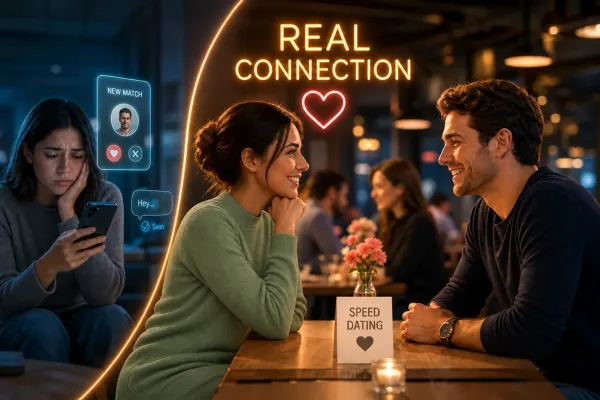
If you've ever wondered why speed dating is more effective than online dating, the answer isn't just instinct, it's structure. Picture this: you've been on dating apps for two years. You've swiped thousands of times, exchanged hundreds of messages that went nowhere, and sat through a parade of coffee dates with people who looked nothing like their photos. Your Thursday evenings belong to your phone. Then a friend convinces you to spend one evening at a speed dating event in Calgary. Six minutes per conversation, a room full of real people, and by the end of the night, you've had three genuine exchanges that felt more alive than anything your app feed produced all year.
That contrast is what this article is actually about. Not cheerleading for one side, but a real look at why structured, in-person dating events produce a different kind of result than asynchronous apps. We'll walk through conversation quality, match rates, time efficiency, and who genuinely benefits most from each format. By the end, you'll have enough to make a clear-eyed decision for yourself.
Canadian singles using dating apps spend somewhere between six and ten hours per week on them, and a 2025 survey found that 55% had gone on zero dates in the previous year. That is a significant investment of time and emotional energy for an outcome that, statistically, looks pretty thin. The problem isn't effort; it's structure. Apps are built for browsing, not for deciding. The paradox of choice is real: when you have access to thousands of potential matches, each individual one feels less significant, and the bar for investing in any one conversation keeps quietly rising.
The result is what researchers and everyday users alike call dating-app fatigue: a mix of exhaustion, emotional numbness, and the gnawing suspicion that the next swipe will be just as unsatisfying as the last. Among Canadian singles aged 30 to 55, the most commonly reported complaints include ghosting, conversations that go nowhere, and the overwhelming sense that the whole process feels transactional rather than relational.
Here is a structural reality that most people don't consciously name: dating apps make money when you keep using them. A successful match that leads you to delete the app is, from a business model perspective, a lost customer. This isn't a conspiracy theory; it's simply how engagement-driven incentive design works, a pattern well-documented in platform economy research. AI-driven feeds, algorithmic ranking, and engagement-optimizing features are all built to keep you swiping, not to get you to a second date faster.
This doesn't mean apps are useless. They solve real access problems. But it does mean that the interests of the platform and the interests of the user are not always aligned. Once you see that clearly, it becomes easier to understand why an entirely different format, one built around a single evening and a fixed number of conversations, might produce a very different emotional experience.
Face-to-face encounters transmit compatibility signals through facial expressions, vocal tone, posture, and eye contact that no profile photo or carefully curated bio can replicate. These aren't just nice extras. When you sit across from someone, you know within moments whether there is ease in the conversation, whether their laugh is genuine, whether you feel comfortable or guarded. That kind of information is irreplaceable, and it's exactly what gets lost in a text-based exchange.
Anyone who has switched from months of texting to a five-minute face-to-face conversation knows the difference immediately. Social presence research, the study of how connected people feel during communication, consistently finds that shared physical space produces stronger engagement and perceived communication effectiveness than text-based interaction. Short in-person interactions routinely provide richer social information than extended digital exchanges, which is a core reason why speed dating vs. online dating isn't really a close comparison when it comes to reading another person.
It's a well-documented pattern in social psychology that trust forms faster in person than through text, and in dating, that difference is felt immediately. In-person meetings create a kind of mutual commitment that asynchronous apps simply cannot manufacture. Both people showed up. Both people are visibly present. Both people are responding in real time, in front of others. That public accountability changes behavior in meaningful ways. Misrepresenting yourself through a profile becomes irrelevant when the person sitting across from you can see exactly who you are.
For people who have experienced the emotional wear of online dating, this shift in accountability can feel like a genuine relief. There's no lag, no ambiguity about tone, and no disappearing act mid-conversation. Picture the contrast: instead of a week of slow-burn messaging followed by silence, you walk away from an evening with clear answers. That honesty is built into the format itself.
A structured five-to-seven minute conversation under mild social pressure activates the same instincts people use in job interviews, introductions to new colleagues, and first meetings with a friend of a friend. The clock creates a useful constraint: performative small talk drops away quickly because there isn't time for it. People tend to ask real questions and give real answers, partly out of genuine curiosity and partly because they know the next rotation is coming.
Contrast this with the drawn-out messaging arc of most app interactions, where two people can build a strong sense of familiarity over weeks without ever sitting in the same room. That familiarity is often a kind of fiction. The first in-person meeting can collapse it entirely, or confirm it. Speed dating compresses that process into a single evening, which is far more efficient and emotionally honest.
Ghosting is one of the most consistently cited negative experiences in online dating, particularly for women. Someone who seemed interested simply stops responding, without explanation, and the psychological cost of that ambiguity accumulates over time. Speed dating significantly reduces that ambiguity: every conversation completes in the room, and mutual interest is signaled through a structured post-event process, usually a match notification, rather than a prolonged, anxious wait. Post-event non-responses can still happen, but the format eliminates the drawn-out silence that makes app ghosting so draining.
The format itself provides emotional protection. Many attendees report going home knowing exactly how many mutual connections they made, rather than spending days wondering. That clarity, even when a particular evening doesn't produce a match, is genuinely valuable for mental health and for keeping dating from feeling like a drain.
Across multiple event organizers, between 67% and 94% of attendees receive at least one mutual match from a single event, treat the upper end of that range as a best-case figure, since definitions of "match" vary by organizer. One virtual speed dating study found that 95% of matched participants went on a follow-up date, though that figure reflects a research-context event rather than a typical commercial night out. Even at the conservative end, the directional point is real: a single structured event, lasting two to three hours, reliably produces mutual interest signals for the majority of people who attend.
Compare that to the typical app experience: weeks of messaging before a first date, high drop-off between matching and conversation, and even higher drop-off between conversation and actually meeting in person. The conversion funnel for apps is long, leaky, and emotionally expensive at each stage. This is one of the clearest illustrations of why speed dating beats online dating on efficiency alone.
A speed dating ticket typically runs between $30 and $50. That's the sticker price. The more useful comparison is cost per meaningful interaction. Many attendees walk away from one evening with several quality conversations and at least one follow-up, an outcome that compares very favourably to months of app subscriptions and hours per week of swiping. When you frame it that way, the math shifts considerably.
To be fair: online dating makes genuine sense for people in smaller or rural communities where local events aren't available, for those with very specific partner criteria that benefit from large-pool filtering.
Busy professionals who value time efficiency tend to find speed dating immediately appealing, because the format respects that time is finite. People who feel that digital communication strips away authenticity find that the live format delivers what they've been missing. Singles re-entering the dating scene after a long relationship, particularly those who feel unfamiliar or uncomfortable with apps, often find in-person events feel more natural and less overwhelming than navigating a new platform from scratch.
Introverts often surprise themselves at speed dating events. The structure removes the hardest part of any social situation: the cold approach. Assigned seating, a clear format, and timed conversations mean that every person in the room gets attention and every conversation has a beginning and an end. Research on structured versus unstructured social settings supports the idea that shy singles participate more fully in organized events than in open-format gatherings, where quieter people are often overlooked in favor of more outgoing attendees.
Apps have real advantages in specific circumstances. If you're in a smaller town without regular local events, if you're seeking a partner across geographic boundaries, or if you have very particular criteria that benefit from filtering a large pool, online dating is the more practical tool. Acknowledging this honestly makes the case for in-person events more credible, not less, and it's part of why speed dating vs. online dating isn't a one-size-fits-all question.
Calgary Speed Dating has been operating since 2008, over 18 years of in-person events as of 2026, and the organizer-reported results are notable: an 80%+ match rate across events, built not by an algorithm but by real evenings at Calgary venues like Rodney's. Events are hosted by Cathy, who has spent nearly two decades cultivating an atmosphere where people feel genuinely welcomed rather than evaluated. The operation has earned enough trust locally to set a Guinness World Record for the largest speed dating event ever held: 651 attendees on February 14, 2014. That kind of scale doesn't happen without a community that believes in what you're doing.
That organizer-reported 80%+ match rate isn't a platform's promise backed by engagement metrics. It comes from real rooms, real conversations, and a format refined over years of watching what actually works for Calgary singles.
The outcomes from Calgary Speed Dating's events go well beyond match notifications. Organizers report couples who met at events and went on to marry, and singles who spent years cycling through apps and found a genuine connection on their first night in the room. These aren't edge cases held up because they're rare; they're the reason the business has been running for nearly two decades and continues to fill events every month.
If you're a single in Calgary and curious about what one evening might look like, the easiest next step is to join the interest list. You'll get notified by email or text when the next event is scheduled, and you can decide from there. No pressure, no algorithm, no second job. Just one evening worth trying.
Neither speed dating nor online dating is perfect for every person in every situation. If you're in a rural area or have very specific criteria, apps might serve you well. But if you've been swiping for months or years and still haven't found the kind of connection you're actually looking for, that's worth paying attention to. The format isn't working for you, and trying a different one isn't giving up, it's being practical.
Speed dating's real advantage isn't just a match percentage or a stat on a slide deck. It's the feeling of walking out of an evening knowing you had three real conversations with real people who were genuinely there. For anyone still on the fence about why speed dating is more effective than online dating, that experience tends to be more persuasive than any article. If you're in Calgary and ready to find out for yourself, Calgary Speed Dating has been creating exactly that kind of evening since 2008. Get in touch and find out when the next event is on.
